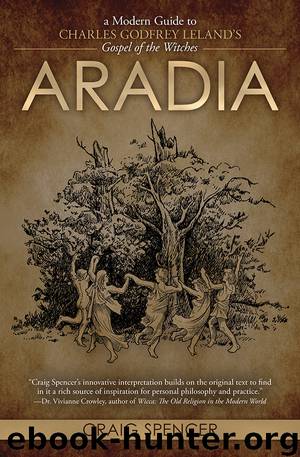
Aradia by Craig Spencer
Author:Craig Spencer
Language: eng
Format: epub
Tags: italian witchcraft;witchcraft;witches;history of witchcraft;aradia;gospel of the witches;gospel of witches;charles godfrey;charles godfrey leland;charles leland;historical witchcraft;history of paganism;pagan;pagan history;pagan book;pagan books;CVR10222019;CVR01162020;CVR01172020;CVR01202020
Publisher: Llewellyn Worldwide, LTD.
Published: 2020-06-16T19:15:50+00:00
The Revelations
This chapter of Leland’s work is difficult to find much merit in. Firstly, he provides none of the original Italian text to translate, leaving only his translations to rely on, which have not always been very reliable. Secondly, this tale does not belong to the original Gospel texts. This is most likely why Tana becomes the Goddess of the Moon, as in this tale the moon does not yet have one. This is a far cry from the Gospel texts that put Diana as the moon goddess from the very first moment of creation.
It can therefore be argued that not only does this story not fit “the same subject” of the Gospel as Leland implies, but it is likely that Tana and the moon goddess are completely different individuals. It would appear that it is in fact the moon goddess who answers Tana’s plea, which would be more relevant to the Gospel than its present form. What is beneficial about this story to witches today is that an incantation to influence the heart and mind of a wrongdoer is included. This can be of great value to the practical witch.
In the opening passage Leland explains that this text originally came with the name Fana, not Tana. This appears to be an error; the real name should actually be Fauna. Neither Fana nor Tana have appeared anywhere in my research in relation to events as described in Leland’s work, with the exception of his work. In the tales of the goddess Fauna, it is said that not only is she the goddess of animals and wild places, but she is also a gifted prophetess with the power to speak of future events or inspire such speech in others.
Regardless, Fauna does not completely fit into this story either. For this reason I speculate that the name is a shortened form of Titania. Returning to the themes found in Shakespeare’s A Midsummer Night’s Dream, the Queen of the Fairy is named Titania. This name may sound familiar as Leland has compared Titania to Diana in previous chapters. Titania first enters Shakespeare’s play having returned from India.36 This may add a further rationale to the chestnuts-from-India reference that Tana uses in her counter-charm in chapter Nine. Could Tana actually be Titania?
Download
This site does not store any files on its server. We only index and link to content provided by other sites. Please contact the content providers to delete copyright contents if any and email us, we'll remove relevant links or contents immediately.
Becoming Supernatural by Dr. Joe Dispenza(8225)
Crystal Healing for Women by Mariah K. Lyons(7936)
The Witchcraft of Salem Village by Shirley Jackson(7280)
Inner Engineering: A Yogi's Guide to Joy by Sadhguru(6800)
The Four Agreements by Don Miguel Ruiz(6770)
The Power of Now: A Guide to Spiritual Enlightenment by Eckhart Tolle(5790)
Secrets of Antigravity Propulsion: Tesla, UFOs, and Classified Aerospace Technology by Ph.D. Paul A. Laviolette(5374)
The Wisdom of Sundays by Oprah Winfrey(5168)
Room 212 by Kate Stewart(5130)
Pale Blue Dot by Carl Sagan(5013)
Fear by Osho(4743)
The David Icke Guide to the Global Conspiracy (and how to end it) by David Icke(4724)
Animal Frequency by Melissa Alvarez(4478)
Rising Strong by Brene Brown(4467)
How to Change Your Mind by Michael Pollan(4361)
Sigil Witchery by Laura Tempest Zakroff(4250)
Man and His Symbols by Carl Gustav Jung(4142)
Real Magic by Dean Radin PhD(4134)
The Art of Happiness by The Dalai Lama(4133)
